
The Runaway
By Laura Zapata Castrillon
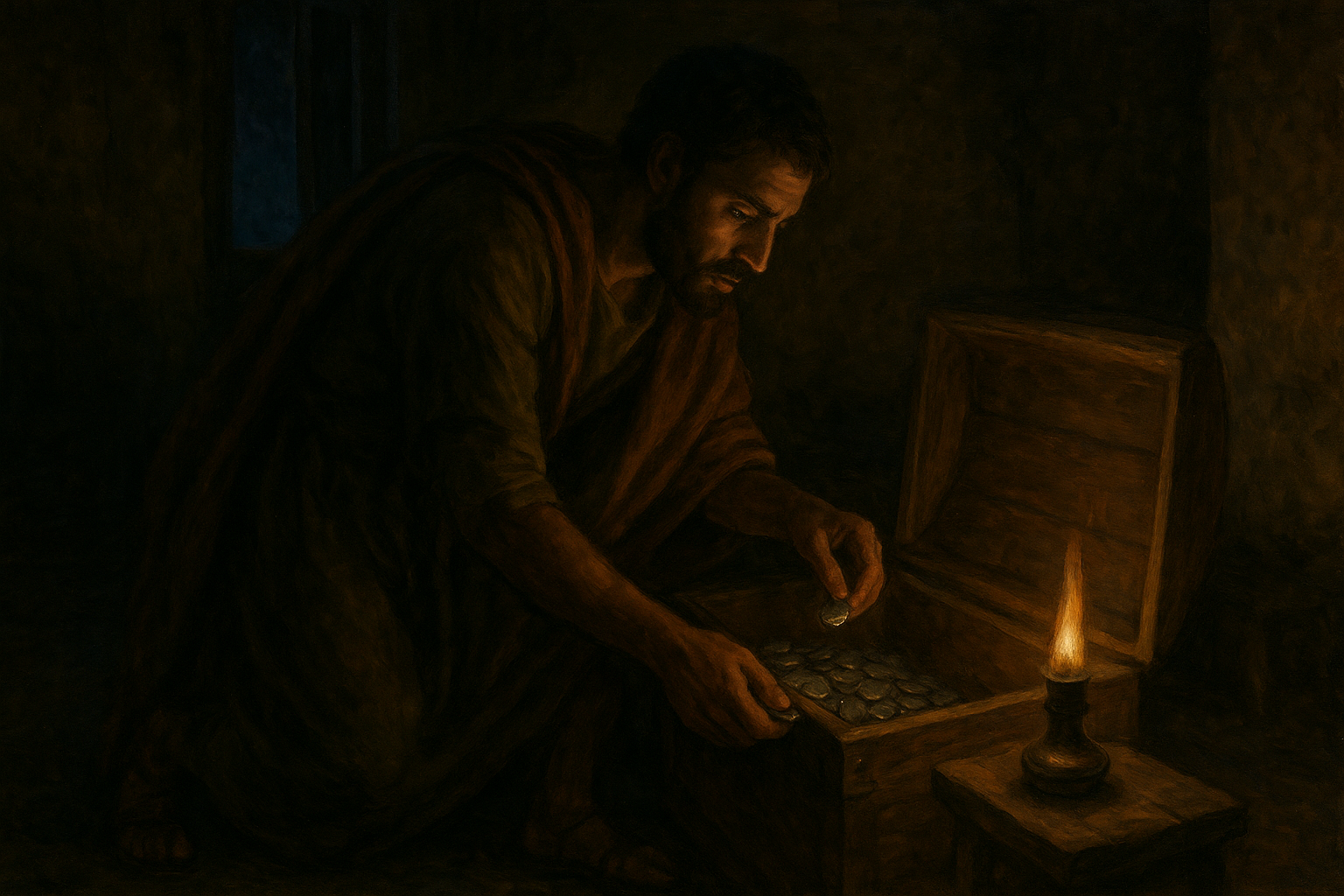
Night falls quietly over the house. Everyone lies asleep: the servants, the guests, even the animals. But among the dark corners of the quiet household, a restless figure slips quietly between the marble columns of the central courtyard.
Crossing with ease the curtained threshold, he enters what appears to be a private chamber of the house. He does not hesitate or stumble. Every corner, every piece of furniture, and shadow is familiar to him—he is at home in this place.
With soft, calculated steps, he approaches the wooden chests lined against the wall. Opening one of them, he searches until his hand closes on the small brown pouch. His body shudders when his fingers slide inside the pouch and touch the cold metal. He knows it isn’t right, he knows he shouldn’t take it—yet without hesitation he hides the pouch beneath his tunic and closes the chest.
Wrapping his head in his cloak, he crosses the room in silence. Once more, he passes through the courtyard and, reaching a narrow wooden door, slips into the empty street, where in an instant his figure disappears into the darkness.
Rome, A.D. 62
“Onesimus, did you hear me?” The gray-haired man shackled in chains, gently shakes the shoulder of the slender young man who had been resting his head against the stone wall, like lost in thought.
The question strikes him like a flash of lightning, startling him back to reality. “Brother Paul… you ask me to return to Philemon?” he stammers, his pupils widening like those of a frightened cat.
He falls silent for a moment, swallows hard, his voice breaking— “I don’t know if I have the courage… I’ve been free for so little time! Should I return to my master’s house and risk everything?”
Onesimus lowers his head and buries his face in his shaking hands.
Returning would be madness. It would mean not only risking his freedom but also his very own life. Everyone knew about the fate of a runaway slave in the Roman Empire: cruel punishments, torture, painful branding, and often, death.
Tears start streaming down his face.
He knows his bitter reality: slaves have no rights and no name. He has just begun to taste what it means to
be libertas—yet his freedom is not an honest one. It has not been won by purchase or inheritance, but by stealing, fleeing, and hiding.
Onesimus had robbed his master and fled from Colossae under the cover of night. Rome, with its endless crowds, seemed like the perfect place to hide. But the God who never loses track of His own followed him there.
Through the wide community of Christians quietly living in the city he was reunited with Paul, the aged apostle in prison, once a dear friend of his master Philemon. It was to him that Onesimus offered his strength and service, and in serving Paul, he came to know another Master, far greater than any earthly lord. Jesus had stepped into his story and seized his heart. From then on, Onesimus still called himself a slave, yes—but now a slave of Christ. And in that servitude, he discovered a new freedom better than any independence: freedom from sin, and the peace and joy of
belonging to a Lord whose yoke is easy and whose burden is light. All Onesimus wants now is to serve Christ and follow His way.
Yet, each time he hears the name Philemon, his throat tightens and his legs quiver. His body is free, but his conscience isn’t yet completely at peace. He taken what wasn’t his, and he must return it.
“You must return to Philemon” Paul’s voice is firm yet tender, “It is for freedom that Christ has set you free, but freedom without a clear conscience only becomes another kind of slavery.”
“I want to be truly free” Onesimus chokes his words through tears. “I want to have all my sins forgiven and every wrong I’ve ever done, redeemed.”
“Onesimus, I could keep you here with me—you have been a great help in my chains,” Paul reaches across a wooden table faintly lit by a candle and takes a small scroll of papyrus. “But the time has come to exchange even your freedom for the forgiveness and peace Christ offers.”
“What about my debt?” Onesimus takes a deep breath and dries up his tears—Even if I return and ask for forgiveness, I could never repay what I have stolen from him.”
Laying a tender hand upon the young man’s shoulder, Paul smiles and says, “Go in peace, my son. I will pay what you owe your master. And he, as a captive and debtor of Christ, will forgive you and show kindness. For only by risking what you most love can Philemon show the world that in Christ there is neither master nor slave, neither man nor woman; we are all one in Him—children, though debtors and undeserving, bound to the mercy and forgiveness of our Lord.”
Finishing the letter Paul ties it with a linen string, presses a drop of melted wax over the knot and holds it out to Onesimus. “Hand this letter to Philemon at your arrival—my words will speak for you, if yours should falter.”
The Homecoming
Days later, Onesimus, accompanied by Tychicus—a faithful servant of Paul—watches Rome fade into the distance aboard a ship that sails toward Ephesus, the coastal city where many of Philemon’s fellow Christians gather each Sabbath to study the Word of God.
When the ship reaches shore, word spreads quickly among the believers. “Onesimus? The runaway slave?” Many can hardly believe it. His return stirs whispers and questions, and all wonder how brother Philemon will react to seeing the slave who betrayed him standing at his door.
After sharing with the church how Jesus has transformed his life and how he has served Paul in prison. Onesimus risks the final step. He sets out for Colossae, to Philemon’s house.
The soft breeze brushes his olive skin as he walks through the familiar streets of Colossae. In his hand, he holds Paul’s letter—his guarantee. This time, his head is not hidden beneath a cloak; his face meets the sunlight directly.
“He is back!” startled eyes follow Onesimus through the streets, as he responds with a calm smile.
At last, he reaches Philemon’s house and taking a deep breath, he knocks firmly on the wooden door.
The door swings open, and a servant girl drops her jaw. She darts inside and returns bringing Philemon behind her.
“Onesimus?” Philemon’s eyes widen. Shaking his head in disbelief, he approaches the threshold.
Kneeling, Onesimus bows his head and lifts up the papyrus scroll. In an instant, Apphia, Philemon’s wife, and his son Archippus appear behind him, mouths wide open.
Philemon takes the scroll, breaks the seal, and quickly begins to unroll it.
“It’s a letter from our beloved Brother Paul!” Philemon’s voice vibrates with excitement. “Stand up, Onesimus. Tell us good news about our beloved apostle!”
Tychicus, who accompanies Onesimus, helps him to his feet.
“Read the letter!” exclaims Sister Apphia, lifting her hand to command the servants to guide Onesimus and Tychicus inside.
With a broken voice and full of emotion, Philemon begins to read aloud: — Paul, a prisoner of Christ Jesus, and Timothy our brother, To Philemon our beloved friend and fellow brother…
For the first time, with tear-filled eyes, Onesimus hears the words his dear brother Paul has written on behalf of him. Paul takes responsibility to make amends for all he has stolen, and tenderly calls him a son. Insisting that he is useful for the gospel, Paul affirms that he should no longer be received as a slave, but as a brother.
“Peace and grace be with you, Brother Onesimus!” Filemon exclaims as he finishes reading the letter. “This world no longer defines us; our old customs, our divisions, none of that matters. In Christ, we are all equal, all part of one family. We forgive because we are all debtors—and He forgave us first.”
Hearing these words, Onesimus throws himself into his master’s arms as they share a fraternal embrace, one that all the onlookers know will mark the beginning of a new story—not just for their family and Onesimus, but for all who will witness the love of Christ breaking every barrier and unifying those who accept Him as a savior.
The End
0 Comments