
Come Out of Lo-debar, the King Is Calling You
(Based on 2 Samuel 9)
By Laura Z Castrillon
A Forgotten Prince
“Ziba, Ziba! It’s time, now you must enter the king’s chamber!”
The servant gives me a shove, snapping me out of my stupor, and with hurried steps and heart pounding, I follow him into the private chamber of the palace.
Now I stand before the king’s banquet table. From behind the golden candlesticks, I see his figure rise quickly at my arrival. My knees begin to quiver, not so much out of fear of what might happen to me, but to him… that poor boy with crippled feet, living in Lo-debar.
King David has long been searching for any survivors from the house of Saul, my late lord. After all the years of war between their families, I cannot imagine that Mephibosheth will be thrilled to be found. The last time I saw him, he dragged himself down the dusty streets of Lo-debar—a dry and barren village where despair hangs heavy in the air. It is a lonely place where, according to what some say, not even the word of God can reach such a place[1].
When I think of him—his torn and dusty robes, his dull eyes, his skin cracked by the desert heat—I can hardly believe he was once a prince. What a fate for him! In one fell swoop, his life was taken away from him. His grandfather, King Saul, and his father, Jonathan, were slain in battle. His mother vanished without a trace. His relatives were murdered. The only memory that remains is of him at five years old, dropped by his nurse as she fled in panic. That fall left him lame in both feet, and since then, he has lived as a beggar in hiding, in a town where only the broken, the indebted, the abandoned, and the outcast live.
Is He Still Alive?
“Is anyone still alive from Saul’s family—to whom I can show kindness for Jonathan’s sake?” The king’s eyes pierce through me, wide and searching.
“Yes, Your Majesty,” I answer hesitantly. “One of Jonathan’s sons is still alive. He is crippled in both feet.”
The sudden shift in the king’s expression takes me by surprise. Rather than the fierce stare of a hunter eyeing his prey, his expression gets tainted with deep emotions I cannot yet understand. His eyes grow red and teary. He says nothing for a moment, like lost in memories I dare not interrupt.
“Where is he?” he finally asks.
“In Lo-debar, at the home of Makir son of Ammiel.”
Like a Son
Three days later, Mephibosheth is summoned to appear before the king.
When he is called to enter the court, not only do his feet seem to shuffle, but his entire body. On his crutches, he drags himself down the aisle, head lowered, and eyes fixed on the ground. As he approaches the throne, his entire body hunches and falls to the ground prostrated in reverence.
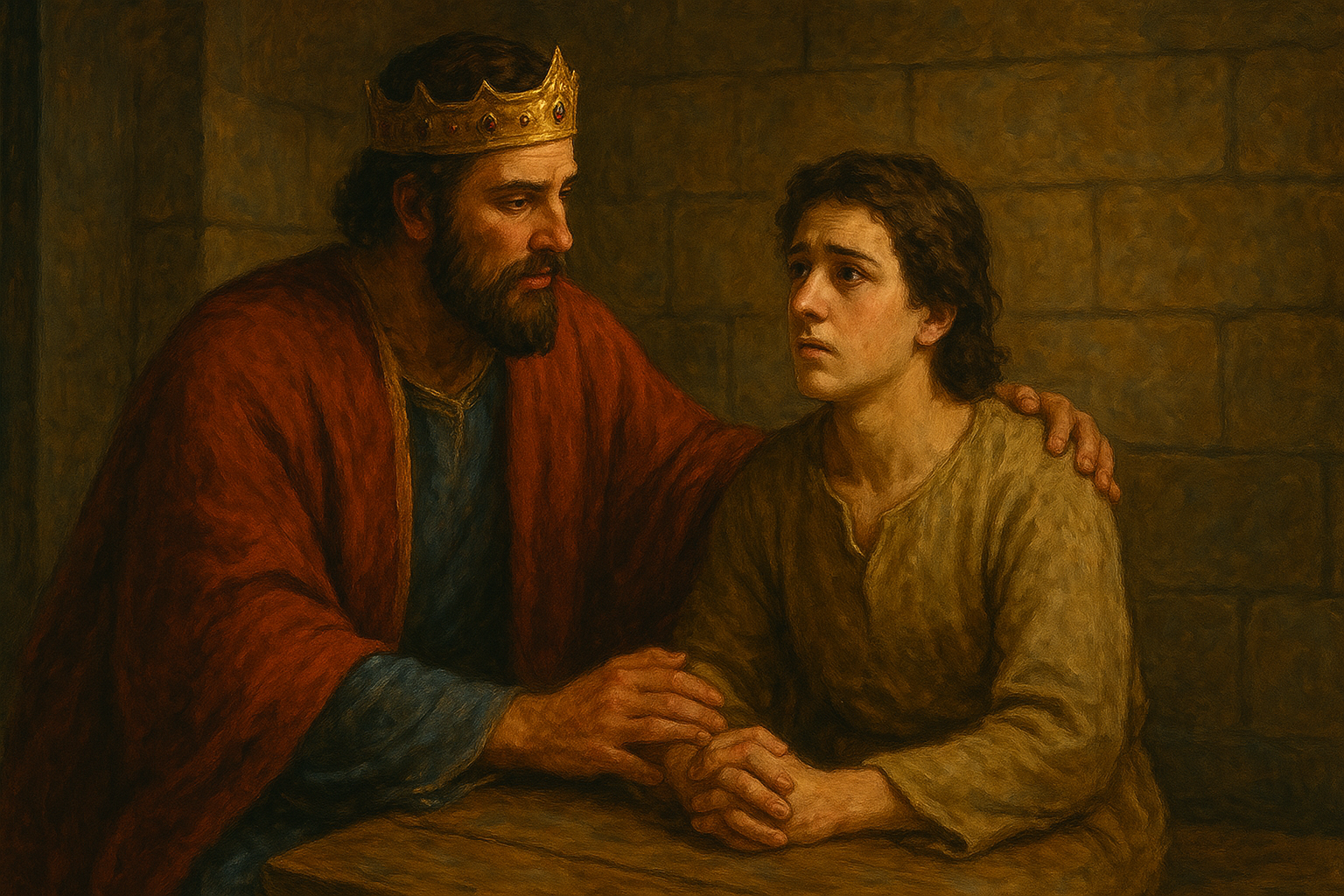
A frown of sadness is drawn on the King’s face. His eyes squint, and tears begin to stream over his cheeks. I am surprised to see how he rises from the throne and bends tenderly over Mephibosheth’s trembling body that remains humbled on the ground.
“Don’t be afraid,” the king’s voice vibrates softly with a tone of compassion. “I intend to show you kindness because of my promise to your father. I will restore to you all the land that belonged to your grandfather Saul, and you will always eat at my table.”
Then it dawns on me: this is not about politics. This is about love and loyalty.
The king’s words are not only for Mephibosheth, they are spoken with the weight of a friendship forged in his youth with Prince Jonathan, Mephibosheth’s father and David’s best friend. I remember they used to be friends while I served in Saul’s house, but little did I know how strong were their bonds of brotherhood.
”Who is your servant, that you should look at a dead dog like me?” Mephibosheth lets out a groan.
At that moment, I also realize that Mephibosheth’s soul condition is as crippled as his feet. His misfortune led him to think about himself as less than human.
But the king does not answer the question. Instead, he turns to me. “Ziba,” he says, “I have given your master’s grandson everything that belonged to Saul. You and your sons and servants are to farm the land for him and provide for his household.”
David leans down gently and lifts Mephibosheth by the shoulders and insists ”But Mephibosheth, your master’s grandson, will eat here at my table.”
For a moment, I cannot believe what I hear, the king is restoring a home for my family, and our lord is no one else than the crippled, forgotten ex-prince of Israel!
I cannot help but agree with my head and put myself at the service of this great king.
But Mephibosheth, though still standing on the king’s shoulders, seems unable to understand what is happening and hides his embarrassed eyes.
For a moment, he tries to pick up his crutches and walk away.
But the king, looking him in the eyes, repeats the words ”Mephibosheth, shall eat at my table” but this time, he smiles softly and adds ”as one of the king’s sons.”
From Outcast to Prince
From that day on, I have lived in abundance with my family as we work the land of our restored lord. We plant, we harvest, and we eat the fruit of what was once lost.
Mephibosheth lives in Jerusalem now, at the king’s palace. He has a little son, Micaiah. And every day, they eat at the king’s table alongside the rest of the princes.
Since the king took him out of Lo-debar, he has been loved deeply. He is an honored guest at the palace and is treated as one of the royal family. As his life changed drastically at the age of five when his family was murdered and he was left crippled, so his life changed entirely when he encountered the king.
Sometimes, when I travel to Jerusalem to offer sacrifices before Yahweh, my lord and I stand and contemplate the Tabernacle. He likes to talk about the promised messiah Israel waits for. The prophecies say that he will save Israel from ruin and that he will reign with kindness over us. They also say that we will eat forever at his table as children of the king.
I rejoice at the thought that this King will come to show us compassion, for many of the children of Israel today live as in Lo-debar, but all have the hope of being restored as Mephibosheth.
[1] [1] Lo-debar was a small village located in the region of Gilead at 13 km from the sea of Galilee. Its name has a sinister meaning, not at all attractive to live there and much less dream of a promising future; etymologically, Lo-debar means “not a word” (Lo = No / Debar = Word), a place where, according to what was believed, “the Word of God did not reach”, therefore its inhabitants were cut off from the rest of Israel and the Lord. Lo-debar has other meanings as ‘’land with no fruits’’ or ‘’arid land’’. It was considered a place for the outcasts of society,
From Outcast to Price
Hi, this is a comment.
To get started with moderating, editing, and deleting comments, please visit the Comments screen in the dashboard.
Commenter avatars come from Gravatar.